

We’re sure there have been more, but these are a few of the publications of academic studies conducted using our equipment…
Published Academic Papers Using NatureCounters Equipment
1. Inhibitory Control in Great Tits
Davidson, G. L., Reichert, M. S., Coomes, J. R., Kulahci, I. G., de la Hera, I., & Quinn, J. L. (2022). Inhibitory control performance is repeatable over time and across contexts in a wild bird population. Animal Behaviour, 187, 305–318.
https://doi.org/10.1016/j.anbehav.2022.02.007
2. Cognitive Flexibility and Heritability
van den Heuvel, K., Quinn, J. L., Kotrschal, A., & van Oers, K. (2023). Artificial selection for reversal learning reveals limited repeatability and no heritability of cognitive flexibility in great tits (Parus major). Proceedings of the Royal Society B: Biological Sciences, 290(2003), 20231067.
https://doi.org/10.1098/rspb.2023.1067
3. Inhibitory Control and Foraging Flexibility
Coomes, J. R., Davidson, G. L., Reichert, M. S., Kulahci, I. G., Troisi, C. A., & Quinn, J. L. (2022). Inhibitory control, exploration behaviour and manipulated ecological context are associated with foraging flexibility in the great tit. Journal of Animal Ecology, 91, 320–333.
https://doi.org/10.1002/2688-8319.12081
4. Sex-Specific Responses to Dietary Stress
de la Hera, I., Dillon, D. G., Woodward, S. L., Davidson, G. L., & Quinn, J. L. (2024). Sex-specific responses to dietary stress in songbirds occur via differences in parental investment rather than nestling physiology. Current Biology, 34(24), 5838–5845.e4.
https://doi.org/10.1016/j.cub.2024.10.055
5. Data Archive for Great Tit Study
Davidson, G. L., Coomes, J. R., de la Hera, I., Kulahci, I. G., Reichert, M. S., & Quinn, J. L. (2022). Data from: Inhibitory control, exploration behaviour and manipulated ecological context are associated with foraging flexibility in the great tit. Dryad Digital Repository.
https://doi.org/10.5061/dryad.x95x69ps8
6. PIT Tag Method for Small Mammal Bait Uptake
Slade, E. M., Roslin, T., Santalahti, M., & Bell, T. (2019). A PIT tag based method for measuring individual bait uptake in small mammals. European Journal of Wildlife Research, 65, 72.
https://doi.org/10.1007/s10344-019-1309-z
(Also available via Academia.edu)
7. Performance-Dependent Movement and Adaptive Divergence
Bestion, E., Clobert, J., & Teyssier, A. (2015). Performance-dependent movement: an alternative driver of adaptive divergence. Functional Ecology, 29(11), 1405–1413.
https://doi.org/10.1111/1365-2435.12465
(Also available via Academia.edu)
8. Meteorological Effects on Bumblebee Activity
Tuell, J. K., & Isaacs, R. (2010). Time series models to quantify short-term effects of meteorological conditions on bumblebee forager activity in agricultural landscapes. Insectes Sociaux, 57(4), 409–419.
https://doi.org/10.1007/s00040-010-0098-7
(Also available via Academia.edu)
9. Monitoring Endangered European Hamster
Tissier, M. L., Handrich, Y., Robin, J.-P., Weitten, M., Pevet, P., Kourkgy, C., & Habold, C. (2019). A focus on the European hamster to illustrate how to monitor endangered species. Scientific Reports, 9, 7489.
https://doi.org/10.1038/s41598-019-43878-6
(Also available via Academia.edu)
10. Rapid Ecological Population Divergence
Bestion, E., Teyssier, A., Aubret, F., Clobert, J., & Cote, J. (2014). Experimental rapid and small-scale ecological population divergence in the absence of current natural selection. Evolution, 68(12), 3512–3525.
https://doi.org/10.1111/evo.12521
(Also available via Academia.edu)
In the news
Probably the most talked about project we have been involved in was the UK government project for the Animal and Plant Health Agency (APHA) to reduce the damage caused by the invasive population of grey squirrels through the distribution of contraceptive bait. This has the potential to be relatively low cost, humane and effective and we love it.
Our involvement was to create the RFID-logging, bait-weighing feeders which enabled the scientific work to be carried out to see which squirrels will take how much bait, how often, and over what area, so that the deployment of contraceptive bait stations in the future can be optimised.
Our project partner at the APHA, Dr. Sarah Beatham, has been on TV talking about the project on BBC and CBC, including demonstrating our RFID bait stations, and we are very proud of our part in facilitating this research:
https://www.cbc.ca/news/world/squirrels-britain-1.6155451
https://www.bbc.co.uk/iplayer/episode/m001zqv6/cumbrias-red-squirrels
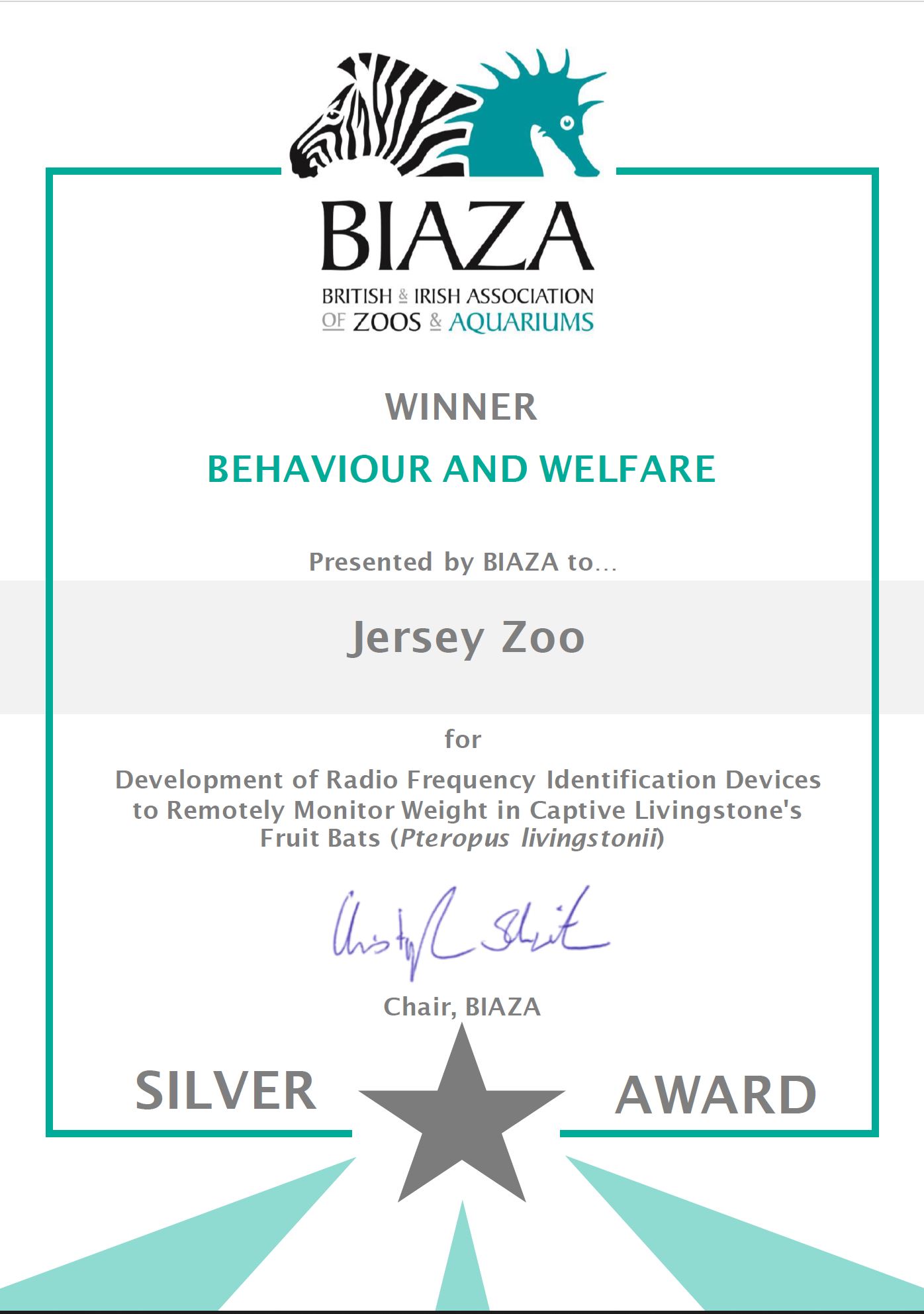
BIAZA Award
We developed our Livingstone’s Fruit Bat RFID weighing station on behalf of Jersey Zoo, who along with Bristol Zoo, hold a significant protion of the entire world popluation of the species, and were awarded a Silver BIAZA (British and Irish Association of Zoos and Aquaria) award under the title:Development of Radio Frequency Identification Devices to Remotely Monitor Weight in Captive Livingstone’s Fruit Bats (Pteropus livingstonii) has been given the award of SILVER for the category Behaviour and Welfare!